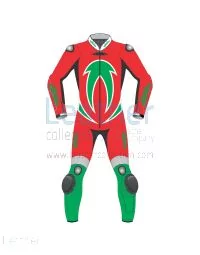
 USA
USA  Canada
  Brazil
  Germany
  France
  Italy
Italy  Switzerland
  Sweden
  Spain
Spain  Great Britain
  Norway
  Russia
  South Africa
  Japan
Japan  New Zealand
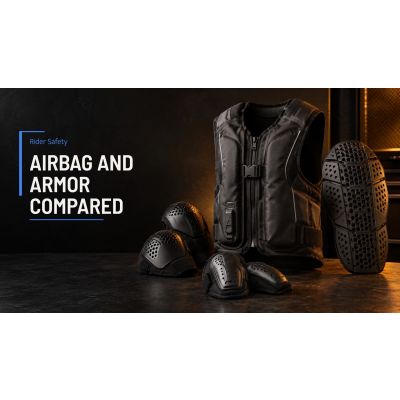
Armour and an airbag protect against different things. Armour is a passive layer that is always in place: it spreads and cushions an impact at the shoulders, elbows, hips, knees and back. An airbag is an active system that inflates around the torso when a crash is detected, so it only helps once it has deployed. Neither replaces the other, and neither replaces an abrasion-resistant outer layer such as leather.
Key Takeaways
- Armour is passive and always present; an airbag must detect a crash and inflate before it can help.
- Airbags mainly cover the torso, so limbs, hands and the outer layer still need their own protection.
- Armour and airbags are tested under separate parts of the EN 1621 standard, each with its own levels.
- Leather handles sliding abrasion, which neither armour nor an airbag is designed to do.
What armour does
Motorcycle armour is a shaped pad, usually foam or a similar energy-absorbing material, that sits in pockets inside a jacket, suit, trousers or glove. Its job is to reduce the force that reaches the body when a rider hits the ground or an object. Because it is a fixed part of the garment, it works from the first moment of a crash and needs no power, sensor or trigger.
The European standard for limb protectors is EN 1621-1. SATRA, a testing body, describes it as the test used to assess the protective qualities of armour worn on the limb joints. It has two levels: Level 1 requires a mean transmitted force below 35 kN (no single value over 50 kN), and Level 2 limits the mean to below 20 kN. Back protectors are covered separately by EN 1621-2, and chest protectors by EN 1621-3.
Armour only protects the area it covers, and only if it sits in the right place. A loose jacket or a suit that shifts on the body can leave a shoulder or knee pad away from the joint it is meant to cover. That is why fit matters as much as the armour itself, whether it is fitted in a or in a riding jacket.
What an airbag does
An airbag system packs a folded bag into a vest, jacket or suit. When a crash is detected, gas fills the bag and it expands around the chest, ribs, shoulders and often the back and neck, spreading the load over a larger area. Airbag vests for horse riding used a cord that triggered inflation when it was pulled in a fall, while modern motorcycle systems use onboard sensors (accelerometer, gyroscope and GPS) and a computer that decides when to inflate, as described on Wikipedia.
Speed of inflation is the key variable. MotoGP.com describes the airbags in its riders' leathers as inflating within 0.045 seconds of the start of a crash, and as protecting the chest, shoulders, ribcage, upper back and neck. That figure is for the racing systems it describes; it is not a promise for any other vest or garment.
An airbag also has built-in limits. It cannot help in a crash it fails to detect, it covers mostly the torso, and it does not protect hands, feet or legs. Whether it can be reused after deploying depends on the system, so the maker's instructions apply.
How each is tested
Both technologies sit in the same standard family but are judged on different things. According to SATRA, EN 1621-4 covers inflatable protectors, with two performance levels: Level 1 for protectors designed to give adequate protection, and Level 2 for items that give more protection than Level 1. Because inflation speed is critical, inflation is analysed with a high-speed camera recording at least 200 frames per second.
| Feature | Armour | Airbag |
|---|---|---|
| How it works | Always in place, absorbs and spreads impact force | Inflates after a crash is detected |
| Needs a trigger | No | Yes (sensor or tether) |
| Typical coverage | Joints, hips, back, depending on pads | Mostly chest, ribs, shoulders, often back and neck |
| Relevant EN 1621 part | Parts 1, 2 and 3 | Part 4 |
| Designed for sliding abrasion | No (the outer layer handles abrasion) | No (the outer layer handles abrasion) |
A standard describes what a tested protector must do in the laboratory. It says nothing about any particular jacket or suit unless that product carries its own documentation. When a listing mentions armour or a standard, check the product page for the armour it lists, and ask for the documentation.
Why the outer layer still matters
In a slide, the first thing that touches the road is the outer material. MotoGP.com notes that riders choose leather for its resistance to abrasion, since sliding on asphalt generates heavy friction and heat. Armour sits under the material and an airbag sits around the torso, so neither one stops skin being scraped away on the limbs and hands.
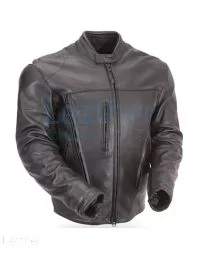
This is why cowhide garments such as a are usually paired with armour rather than treated as an alternative to it. For everyday riding, the same logic applies to a : leather is chosen for abrasion resistance, and armour is a separate matter. The product page lists CE armour on the elbows and no other armour, so a rider who wants shoulder or back protection should ask the maker about it and request the documentation.
Choosing the right mix
The answer depends on how and where a rider rides. A few questions help narrow it down:
- Is the garment already fitted with armour pockets? Many jackets and suits have them. Confirm the armour option before ordering.
- Is there room for an airbag? Vests worn under or over a jacket change the fit, so the outer layer needs enough room.
- Are hands and legs covered? An airbag does not replace gloves, trousers or boots.
- Will the rider wear it every ride? Protection that stays in the closet does nothing.
Hands need their own protection too, so belong in the plan. Riders who want a garment cut to their measurements can look at . The product page describes a made-to-measure fit and lists CE-level armour among its add-ons, so confirm with the maker which armour applies to an order and ask for the documentation.
Frequently Asked Questions
Can an airbag replace armour?
No. An airbag only protects after it has detected a crash and inflated, and it mainly covers the torso. Armour is always in place and covers the joints and back. The two do different jobs, so riders who use an airbag generally keep their armour and outer layer as well.
Does an airbag help with sliding on the road?
Not directly. An airbag is designed to cushion impacts, mostly around the chest, ribs and shoulders. Sliding abrasion is handled by the outer material, such as leather or a tested textile. Check the garment maker's information for what the outer layer is designed to resist.
Which standard covers motorcycle airbags?
EN 1621-4 covers motorcyclists' inflatable protectors, and SATRA lists two performance levels. Armour is covered by other parts of EN 1621. A standard describes laboratory requirements for a tested protector, so ask the maker for documentation on any specific product.
Do MotoGP riders wear airbags?
MotoGP.com describes airbag vests as a standard safety feature integrated into the riders' leathers. Those are racing systems designed for that setting, with their own sensors and activation logic, and they do not tell a road rider which system suits their riding, so the maker's instructions and documentation matter.
Written by the Leather Collection Editorial Team.