
 USA
USA  Canada
  Brazil
  Germany
  France
  Italy
Italy  Switzerland
  Sweden
  Spain
Spain  Great Britain
  Norway
  Russia
  South Africa
  Japan
Japan  New Zealand
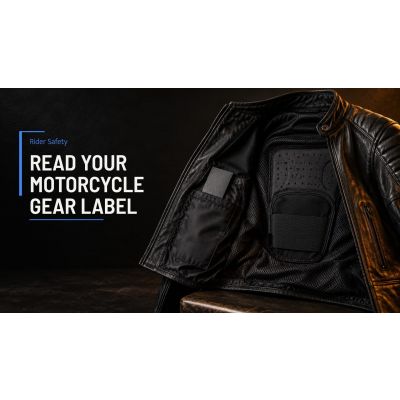
A motorcycle gear label gives three kinds of information: the standard the garment was assessed against (such as EN 17092), a class or level inside that standard (AAA, AA, A, B or C for garments; Level 1 or 2 for armour and gloves), and the body zones the result applies to. Read those three things together and the label becomes a short, comparable summary instead of a row of symbols.
Key Takeaways
- A class or level only means something next to the standard number it belongs to.
- EN 17092 sorts garments into classes AAA, AA, A, B and C; EN 1621 and EN 13594 use Level 1 and Level 2.
- For armour protectors, Level 2 sets a lower transmitted-force limit than Level 1, but fit and coverage still matter.
- Standards describe lab results, not crash outcomes.
- Ask for documentation when a product page does not show a standard.
What a Gear Label Actually Tells You
Most labels combine a standard reference, a pictogram or class, and a care or size panel. The standard reference is the anchor. It names the test method that produced the result, and different standards cover different items: garments, limb protectors, back protectors, gloves and boots. Two items with different standard numbers are not measured on the same scale, even if both show a "1" or "2".
The user information leaflet that comes with the garment is part of the same picture. It should explain what the markings mean and how the item is meant to be used and cleaned, so keep it rather than throwing it away with the packaging.
EN 17092 Garment Classes: AAA, AA, A, B and C
EN 17092 covers protective garments for motorcycle riders. According to SATRA, the standard is split into six parts, with parts two to six covering the classes AAA, AA, A, B and C. Class A offers the lowest level of protection and Class AAA the highest, while B and C are special categories rather than steps on the same ladder.
Two cautions help when comparing labels. First, a class is not a recommendation for a riding style, so it should not be read as "AAA for the track, A for the street". Second, abrasion in this standard is tested on a Darmstadt machine, which SATRA describes as a pass or fail method rather than one that produces a number of seconds. A table of "seconds per class" is therefore not a reliable way to compare garments.
The class applies to a specific garment type, such as a jacket, trousers or a one-piece suit. If a rider wears a jacket and trousers separately, each label stands alone. Browsing motorcycle jackets or on a shop page is easier once the label logic is clear, because the class, the standard and the armour option are the details to look for.
Armour Levels: EN 1621-1 and EN 1621-2
Armour is tested separately from the garment. EN 1621-1 covers limb joint protectors such as knee, elbow, shoulder and hip armour. The test measures the force that passes through the protector when a falling mass strikes it. As summarised on Wikipedia, Level 1 requires a mean transmitted force below 35 kN with no single value above 50 kN, and Level 2 requires a mean below 20 kN.
EN 1621-2 covers back protectors. Level 2 allows lower transmitted force than Level 1 in that standard too. The armour level on a label describes the protector alone, not the whole garment.
| Item | Standard | What the level or class describes |
|---|---|---|
| Jacket, trousers, suit | EN 17092 | Garment class AAA, AA, A, B or C |
| Knee, elbow, shoulder, hip armour | EN 1621-1 | Level 1 or 2, by transmitted force |
| Back protector | EN 1621-2 | Level 1 or 2, by transmitted force |
| Gloves | EN 13594 | Level 1 or 2 |
| Boots | EN 13634 | Footwear performance |
Gloves and Boots Use Their Own Standards
Gloves follow EN 13594. SATRA describes Level 1 as gloves designed to give protection with low ergonomic penalties and Level 2 as gloves giving greater protection than Level 1. SATRA also states that impact protection on the knuckles is optional for Level 1 and mandatory for Level 2. Gloves under EN 13594 are abraded on a Cambridge machine, not the Darmstadt machine used for garments. Boots are covered by EN 13634.
That is why a jacket label cannot vouch for the gloves worn with it. Check the label on each item, including .
Reading a Label Step by Step
1. Find the standard number
Look for EN 17092, EN 1621, EN 13594 or EN 13634. If there is no standard number, a word such as "protective" tells you nothing measurable.
2. Match the class or level to that standard
Read the letter or number as part of the standard it sits under, never on its own.
3. Check which zones are covered
A garment class does not mean every part of it is armoured. Armour is assessed separately from the garment, so check what the product page and order form list for armour and ask for the documentation.
4. Check the size and fit information
Armour only works where it sits. A loose jacket lets padding drift away from the joint, which no label can correct. Race-oriented cuts such as are often cut close to the body for that reason, though sizing should always be confirmed against the size chart.
5. Keep the paperwork
The leaflet and label are the only record of what the maker declared. Follow the garment's care label and the maker's instructions, because the right care depends on the finish and construction of the leather.
What a Label Cannot Tell You
A standard is a laboratory description. The same Wikipedia summary cites a 2017 study by Albanese et al. suggesting that the EN 1621-1 force limits may be too high to effectively reduce the probability of impact injury, which is a reminder that a passing level is a baseline for comparison rather than a promise. Treat labels as a way to ask better questions about fit, coverage and intended use.
Frequently Asked Questions
What does the number or letter on a motorcycle gear label mean?
It depends on the standard. In EN 17092 the letters AAA, AA, A, B and C name the garment class. In EN 1621 and EN 13594 the numbers 1 and 2 name a performance level. A letter or number is only meaningful next to the standard it belongs to, so always read the full reference on the label.
Is Level 2 armour always better than Level 1?
For armour protectors, Level 2 limits the transmitted force more strictly than Level 1, which is a real difference in a lab test. It is only part of the picture, because fit, coverage and comfort also decide whether protection stays in the right place. For gloves, SATRA describes Level 1 as designed for low ergonomic penalties and Level 2 as giving greater protection.
Does a CE mark mean a garment is safe in every crash?
No. A CE mark shows that the maker declares conformity with the relevant rules, and a standard describes laboratory test results under set conditions. No standard promises a particular outcome in a real crash. Use the label to compare garments on the same basis, then check fit and the intended use.
What should I check when a product page does not list a standard?
Look for the standard number, the class or level, and which parts of the garment it covers. If the product page or order form offers an armour option, ask for the documentation for that option before ordering. Absent paperwork is a reason to treat any protection claim as unconfirmed.
Written by the Leather Collection Editorial Team.