 USA
USA  Canada
  Brazil
  Germany
  France
  Italy
Italy  Switzerland
  Sweden
  Spain
Spain  Great Britain
  Norway
  Russia
  South Africa
  Japan
Japan  New Zealand
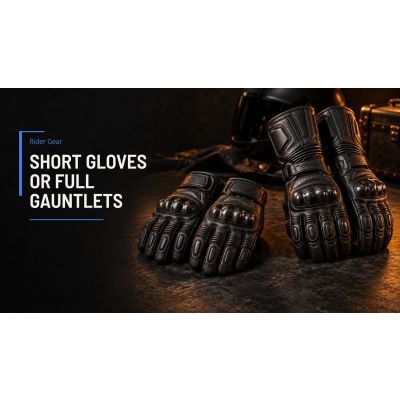
The choice between short and gauntlet motorcycle gloves comes down to how the cuff meets the sleeve, how much of the wrist you want covered, and which palm and knuckle features the riding you do actually calls for. A short glove ends at the wrist and tucks under or beside a jacket cuff. A gauntlet extends over the sleeve and gives the wrist and forearm more coverage. Both styles can carry palm sliders, reinforced palms and knuckle protection, so the cuff is only the first decision.
Key Takeaways
- Short gloves suit warm-weather and city riding where the wrist needs freedom; gauntlets cover more of the wrist and sit over the jacket sleeve.
- EN 13594 describes two performance levels; Level 2 requires a longer cuff and mandatory knuckle impact testing, while knuckle protection is optional at Level 1.
- Palm reinforcement, seams and fit matter as much as the cuff style.
- Check the product page and ask for the documentation before relying on any protection claim.
Short vs Gauntlet: What Changes
The practical difference is where the glove stops. Short gloves are lighter, easier to put on and simpler to wear with a fitted sleeve, which is why many riders reach for them in summer or for short rides. A gauntlet is longer, so it can be worn over the jacket cuff, which helps keep wind and rain from entering at the wrist. It also leaves less bare skin between glove and sleeve.
Riders who want a race-style look in leather can browse the . Riders shopping for women's sizing can start with the .
Which style fits which riding
| Feature | Short cuff | Gauntlet cuff |
|---|---|---|
| Wrist coverage | Ends at or just above the wrist | Extends over the sleeve |
| Fit with jacket | Sleeve usually goes over the glove or meets it | Glove usually goes over the sleeve |
| Typical use | City, summer and casual riding | Sport, touring and track-style riding |
| Weather sealing at the wrist | Depends on jacket cuff | Easier to close over the sleeve |
These are general tendencies, not rules. A well-fitted short glove and a poorly fitted gauntlet can behave very differently, so closure design and fit count for more than length alone.
What EN 13594 Says About Motorcycle Gloves
EN 13594 is the European standard for protective gloves for motorcycle riders. According to the SATRA summary of EN 13594, Level 1 covers gloves "designed to give protection while having low ergonomic penalties", and Level 2 gives greater protection, possibly with weight and restriction penalties. The two levels differ in several ways that matter when comparing cuff styles.
- Cuff length: SATRA lists a minimum of 5 mm from the wrist line at Level 1 and 50 mm at Level 2.
- Knuckle protection: optional at Level 1 and a mandatory requirement at Level 2, with impact testing on all four knuckles.
- Cut resistance: at Level 1 it applies to palm materials only; at Level 2 it applies to all materials except the fourchette material.
- Abrasion: impact abrasion is tested in the palm area on a Cambridge abrasion machine.
The standard also covers tear strength, seam strength, sizing under EN 420 and innocuousness, meaning limits on harmful substances in materials. Intertek adds that gloves must be CE marked under the EU PPE Regulation 2016/425. Only the standard's text and the maker's documentation can confirm what a specific glove has met, so a gauntlet is not automatically Level 2 and a short glove is not automatically Level 1.
Palm Features to Look At
The palm is the area that meets the road first in many falls, so it deserves a close look. Check these points on any glove.
- Palm layers: a single or double layer of leather, and whether extra panels cover the heel of the hand.
- Sliders or reinforcements: some gloves add a low-friction or reinforced pad at the outer palm edge.
- Seam placement: seams positioned away from the main contact areas, with the stitching sitting inside or flat.
- Finger shape: pre-curved fingers reduce bunching on the bars and keep the grip comfortable over a long ride.
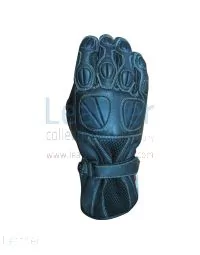
Leather type also affects feel and structure. Cowhide is a common glove material, and some riders prefer thinner leathers for lever feel. The product page for the lists cowhide leather 0.8-0.9 mm thick with sliders on the palm, thumb and fingers.
Knuckle Features and Closures
Knuckle protection is the part of glove design that varies most. Some gloves use hard shells, some use padded inserts and some have no dedicated protection at all. Knuckle protection is optional at Level 1 and mandatory at Level 2; a Level 1 glove that does include impact protection on the knuckles must also be tested for it. So the presence of a knuckle guard does not by itself say which level a glove meets.
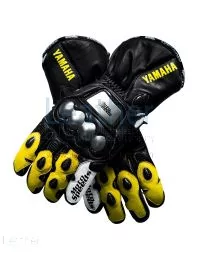
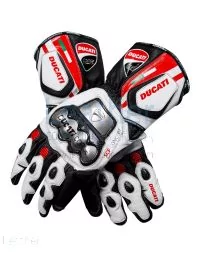
Closures matter just as much. A wrist strap that tightens and a secure cuff closure keep the glove from sliding off the hand. Racing-inspired designs are styled after race-team looks; see, for example, the and the . The product pages list Velcro wrist-strap closures on both pairs, and they are inspired by, not made by or affiliated with, any team. If protection is a priority, read what the product page lists for the knuckles and ask for the documentation.
How to Choose and Fit a Pair
- Decide the riding first: commuting, touring, sport or track-style riding.
- Pick the cuff: short for freedom and warm weather, gauntlet for coverage and sleeve integration.
- Check the features that matter to you: palm layers, knuckle protection and closures.
- Measure your hand and compare it against the maker's size chart.
- Try the glove on with the jacket you will wear and grip a handlebar or a similar tube.
A glove that fits snugly without pinching is easier to control. Too much material at the fingertips can reduce lever feel, and a too-tight glove can restrict blood flow on a long ride. Follow the garment's care label for cleaning, because the right approach depends on the leather and its finish.
Frequently Asked Questions
Are gauntlet gloves safer than short gloves?
Not automatically. A gauntlet covers more of the wrist and sits over the sleeve, but protection depends on construction, materials and fit. EN 13594 describes performance levels for gloves of either length, and a Level 2 glove has a longer minimum cuff. Check the documentation for a specific pair rather than assuming the cuff length decides it.
Is knuckle protection required on motorcycle gloves?
Under EN 13594 knuckle protection is optional at Level 1 and a mandatory requirement at Level 2, according to SATRA. Whether a glove carries it, and how it was tested, is something to check on the product page and in the maker's documentation. Riders who want knuckle protection should look for it explicitly.
How tight should motorcycle gloves fit?
Snug across the palm and fingers, with no folds of material in the grip and no pressure at the fingertips. The glove should close firmly at the wrist so it stays in place. Leather can soften with wear, so a very slight snugness when new is common, but pain or numbness means the size is wrong.
Can short gloves be worn with a race suit?
Many riders pair gauntlet gloves with race suits because the cuff covers the sleeve opening and keeps the glove and suit aligned. Short gloves can also be worn if the sleeve cuff fits closely over them. A practical check is to put both on and move through a riding position, looking for gaps at the wrist.
Written by the Leather Collection Editorial Team.