 USA
 Canada
 Brazil
 Germany
 France
 Italy
 Switzerland
 Sweden
 Spain
 Great Britain
 Norway
 Russia
 South Africa
 Japan
 New Zealand

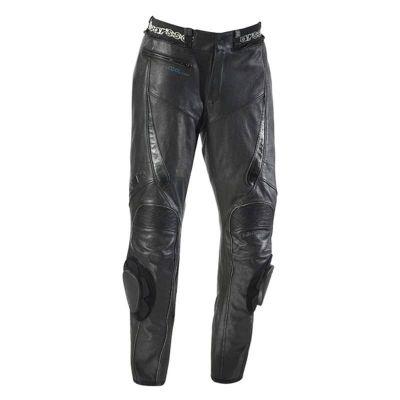
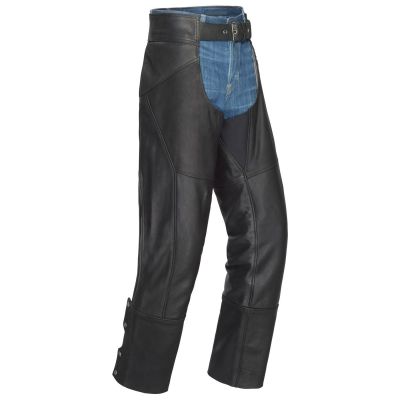
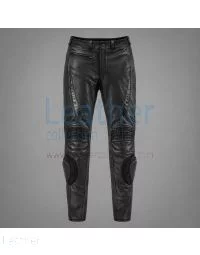
Short answer: choose motorcycle leather pants by protection first: abrasion-resistant leather, strong seams, and pockets for knee and hip armor. Then check the cut for the way you ride, and measure for the riding position, not standing. If you plan to wear a jacket with them, look for a zip that connects the two. Browse our custom motorcycle pants or the motorcycle riding pants to compare.
Why leather for the legs
In a fall, the legs often slide along the road surface before anything else. Leather is a traditional choice for that reason: a thick hide is a durable sliding surface, and well-made seams keep the panels together. Cowhide is common in riding pants; kangaroo leather is also used in some riding gear. Searches such as "leather riding pants" and "leather motorcycle trousers" cover the same garment.
Protection does not come from leather alone. Knees and hips are the joints most exposed in a slide, so riding pants usually include pockets for removable armor. Leather pants without armor pockets suit a different purpose than pants built for fast or long-distance riding. If you are comparing them with other materials, read leather pants vs riding jeans vs textile trousers.
What the standards cover
Motorcycle protective clothing sold in Europe is covered by EN 17092. According to SATRA's overview of the standard, it defines five classes, AAA, AA, A, B and C. Class AAA gives the highest level of protection from impact and abrasion, class AA is described as versatile across riding activities, and class A has minimal ergonomic penalties for warm conditions. The standard tests abrasion on a Darmstadt machine, where a hole of 5 mm or more counts as a failure, and tests seam strength and tear strength as well.
Armor is covered separately. EN 1621-1 applies to limb protectors such as knee and hip armor: Level 1 requires a mean transmitted force below 35 kN with no single value over 50 kN, and Level 2 requires a mean below 20 kN. A class applies only to a garment that has actually been tested, so check the label of the specific pants. Our riding pants have removable CE Level 1 knee and hip armor (EN 1621-1) and no whole-garment EN 17092 class. For a plain-language explanation, see decoding CE ratings and EN 17092 and what is CE armor.
Features to check, one by one
| Feature | What it does | What to check |
|---|---|---|
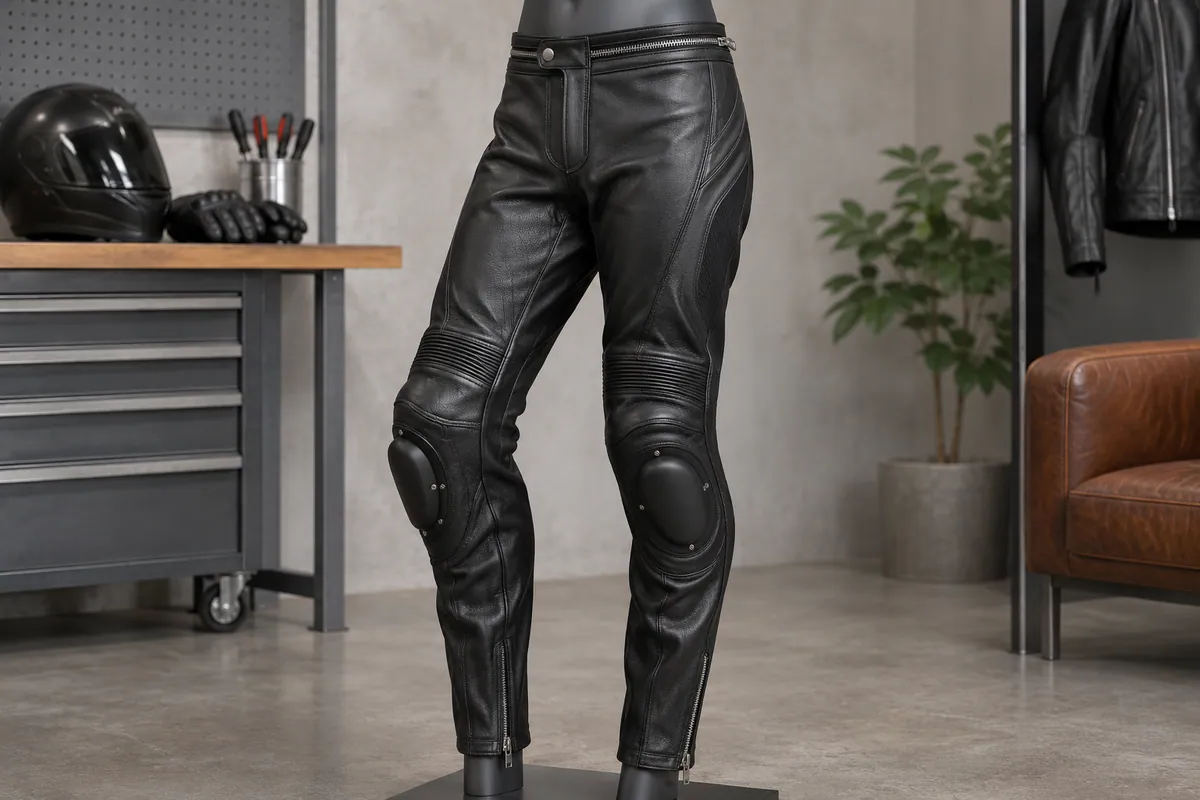
| Knee armor pockets | Hold removable knee protectors | Ours include removable CE Level 1 armor; position over the kneecap |
| Hip armor pockets | Hold hip protectors | Ours include removable CE Level 1 hip armor |
| Knee sliders | Replaceable pucks at the knee for track riding | Needed for knee-down riding only; sliders can be added to our pants |
| Zip-to-jacket | Zipper around the waist joins pants to a jacket | Needs a matching jacket zipper. Stops the jacket from riding up, and approaches a two-piece suit |
| Stretch panels | Flex at the knee, back and seat | Check position; they ease movement but are not abrasion zones |
| Ventilation | Perforation or zips for airflow | Gives warm-weather comfort; protection varies |
| Adjusters | Waist straps, ankle zips | Fine tune the fit and fit over boots |
Zip-to-jacket connection
A waist zipper joins the pants to the jacket so the two work as a single piece. It keeps the jacket from riding up in a slide and keeps the back from being exposed when you lean forward. If you want it, check that your jacket has the matching zip. Our guide to motorcycle racing jacket vs full race suit and one-piece vs two-piece leathers shows how this connection is used. See custom motorcycle jackets. Our riding pants can zip to a jacket.
Sizing in the riding position
Standing and sitting measurements are different. Pants that fit well in a shop can pull behind the knee or bunch at the seat once you are on the bike.
- Waist: measure where the pants will sit, with the jacket on if you plan a connection.
- Seat and thigh: measure the fullest point. In a crouch the thigh grows.
- Inseam, standing: from the crotch to the ankle.
- Knee height: from the floor to the center of the kneecap. This sets where the armor sits.
- Test in a crouch. The seat, thigh and back of the knee should not pull. The knee protector should stay over the kneecap.
Loose leather can bunch and let the armor move away from the joint. Snug is better, but not restrictive. Our leather pants size chart guide explains each measurement. For made-to-measure sizing, see custom leather pants.
Styles: racing, touring and street
- Racing pants: a close, aerodynamic cut for track use, usually with knee sliders and armor pockets.
- Touring pants: more room and often stretch panels for long days in the saddle.
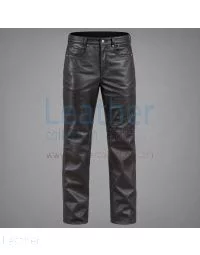
- Street pants: a casual look with fewer visible protective details. Check the armor pockets or included armor before riding. A style such as the 5-pocket jeans-style motorcycle pants is an example.
Care and replacement
Follow the garment's care label or the maker's instructions. Dry the pants away from direct heat, store them in a cool, dry place out of direct sunlight, and check seams and armor pockets regularly. Armor that has taken a hard impact should be inspected or replaced following the manufacturer's guidance. See how to care for leather gear.
When leather pants are not the right choice
In hot weather, leather is uncomfortable unless it is perforated or ventilated. For commuting in rain, textile trousers with a waterproof liner may suit better. For short urban trips, riding jeans with armor may be more convenient. See airbag vs armor in riding gear for more on protection choices.
FAQs
Do leather riding pants include knee and hip armor?
Many do, but not all. Riding pants often have pockets for removable knee and hip protectors, tested under EN 1621-1 as Level 1 or Level 2. Ours have removable CE Level 1 armor at the knees and hips. Fashion-oriented leather pants may have no armor pockets at all.
How should motorcycle leather pants fit?
Snug without restricting movement. In the riding position they should not pull behind the knee, and the knee protectors should stay centered on the joint.
Do I need knee sliders?
Only for track riding with knee-down cornering. Street riders can choose pants without them. Knee sliders can be added to ours.
What is the difference between EN 17092 classes AAA and AA?
Class AAA offers the highest level of protection from impact and abrasion, while class AA is a versatile level for a wider range of riding. Check the class on the specific pants.
Can I join my pants to my jacket?
If both have a matching connecting zip. Check before you order.
Ready to choose? See custom motorcycle pants, and have your measurements taken in the riding position.